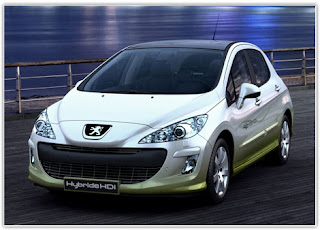
 A step towards commercialization
Compared to the previous 307 Hybrid HDi demonstrator presented in 2006, the focus of the development has now switched to concentrating on the packaging of the hybrid technology into the structure of the new 308, and to ensure its compatibility with the future Euro V emission standards.
To ensure a competitive purchase price, priority has been given to using as many components as possible from current Peugeot vehicles. This has enabled the number of specific parts associated with the hybridization of the 308 to be reduced by around 30% compared to the previous 307 Hybrid HDi demonstrator.
A simple, automatic technologyThe vehicle is started by a customary ignition key but, unlike a conventional vehicle, this does not start the diesel engine. Instead by pressing the accelerator pedal with the gearbox in automatic mode, the electric motor powers the vehicle. The diesel engine only operates when required and is controlled by a stop and start system. All the powertrain operating modes are controlled by a Power Train Management Unit (PTMU) according to the driver's requirements.
The driver is informed in real time of the powertrain operating mode by a schematic diagram on the vehicle's color multifunction display. Other information is also available, such as the battery charge status or the power train operation mode.
Well equipped and without compromiseThe comprehensively equipped demonstrator has all the standard equipment of a Premium Pack 308 and also includes a panoramic glass roof and the RT4 multi-media system with a retractable color display screen. The level of standard equipment, interior space, interior brightness, dynamic qualities and drivability are no different to those of the standard 308.
General dynamic performance is also comparable to a standard 308 HDi. In-gear acceleration, however, both in town and on the open road, is improved with the Hybrid HDi. Indeed, during in-gear acceleration, the diesel engine is backed up by the electric motor which is able on demand to deliver a power boost of up to 31 bhp (and 96 lb ft of torque).
Optimized Hybrid HDi technologyThe parallel hybrid power train consists of a 1.6 litre HDi DPFS 110 bhp diesel engine and an electric motor with a continuous output of 22 bhp and a torque of 59 lb ft. The Power Train Management Unit (PTMU) selects the right distribution of power from both units to meet the requirements of the driver and minimize fuel consumption.
The electric motor alone is responsible for starting and driving at low speed, while only the diesel engine is used on open roads and motorways, with both units coming into play simultaneously to provide quicker acceleration. The system is fitted with a 6-speed electronically controlled manual gearbox able to operate in automatic or manual sequential mode.
To extend the battery range, kinetic energy recovered during phases of deceleration and braking is used to recharge the batteries. A special button provides access to an all-electric "ZEV" Zero Emission Vehicle mode. Operation of the diesel engine is then restricted to more pronounced acceleration phases or high speed driving. This "ZEV" mode provides total absence of exhaust emissions and noise pollution.
Technical description of main specific componentsThe electric motor is of the synchronous type with permanent magnets, developing a continuous power of 22 bhp and a torque of 59 lb ft. However, intermittently its output can attain 31 bhp and 96 lb ft.
An inverter regulates the 150 to 260 volt current from the high voltage battery pack supplying the electric motor in accordance with the torque requirements determined by the Power Train Management Unit (PTMU).
A new generation battery pack has been developed which delivers an output of 200 volts. It is housed in the spare wheel well and does not, therefore, reduce the available boot volume. The batteries are of the Nickel Metal Hydride (Ni-MH) type.
A converter converts the 200 V from the battery pack into 12 V to supply the vehicle equipment in phases of solely electrical operation.
Managed braking maximizes the recharging of the batteries during phases of deceleration and braking. An Intelligent control of the braking optimizes the distribution between regenerative electric braking and traditional dissipative hydraulic braking. The braking management system gives priority to braking efficiency over the recovery of energy.


 All three body styles of the Ford Focus-rivaling 308, including the hatchback, CC coupe-convertible and the SW station wagon, have been given a new face that subtly incorporates the latest stylistic codes of the Peugeot brand.


